100% Australian Owned & Operated
Calee

Calee Business

Keep your organisation’s schedules organised — and get the right dates to the right people.

Calee Business is the Calee platform for organisations. Structure the calendars your teams, sites and programs actually run on, then publish each one to the audience it belongs to — internally, externally, or both.

People follow what applies to them in the Calee mobile app, on the web, or in the calendar app they already use. Where a shared view helps — a reception, a staff room, an operations area — a Calee Display keeps it visible in the room.

How Calee Business works

  1. Your organisation

    The dates you already keep

    Calendars, files and existing calendar sources across teams, sites and programs.

  2. Calee Business

    Organised into calendars

    Structured by team, site, program or audience, with access set per calendar.

  3. The right audience

    Only what applies to them

    Staff and teams internally; customers, members, participants or families externally.

  4. Where they need it

    In the places they already look

    Calee mobile, the web, their own calendar app, and optional shared Calee Displays.

Getting started

Start with one site, team or calendar group. Expand when it has earned it.

The problem

The problem is rarely a missing calendar.

  • The dates already exist — in Outlook and Microsoft 365, Google Calendar, spreadsheets, PDFs, your website, email threads and internal systems.
  • Each team, site and program keeps its own version, so the people who need a date are not always the people who can see it.
  • When something moves, every copy has to move with it, and anything transferred by hand can be left behind.
  • Adding one more shared calendar does not fix it. Getting the correct schedule to the correct people, and keeping it current, does.

Where an organisation’s dates live today

Usually in several of these at once, maintained by different people.

  • Outlook / Microsoft 365
  • Google Calendar
  • Apple / iCloud
  • Spreadsheets
  • PDFs
  • Your website
  • Email
  • Internal systems
  • Individual teams and sites

Calee Business is not another place to keep a copy. It is where what already exists is organised into calendars, and where each calendar is published to the people it applies to.

What it is for

Three ways organisations use Calee Business

One platform, three patterns. Use one, or combine all three — most organisations start with one and add the others later.

1 · Internal coordination

Coordinate your own organisation

Keep the schedules the organisation runs on in one structured place, entirely internal if that is all you need.

  • Departments, teams and programs
  • Sites, locations and depots
  • Staff and team schedules
  • Shared operational calendars
  • Organisation-wide dates everyone needs
2 · External distribution

Publish calendars to the people you serve

Publish organised calendars the right audiences can follow, so a changed date reaches the people who rely on it.

  • Customers and clients
  • Members and participants
  • Residents and tenants
  • Families and community audiences
  • Contractors and partner organisations
3 · Shared visibility

Keep the plan visible where people gather

Where a persistent shared view is genuinely useful, a Calee Display shows the relevant calendars in the room.

  • Reception and waiting areas
  • Staff rooms and shared spaces
  • Operations and production areas
  • Sites, depots and workshops
  • Community and communal areas

Calee Displays are optional. Most of what Calee Business does happens on phones, on the web and in the calendar apps people already use.

Structure

One organisation. Many calendars. Different audiences.

An organisation is rarely one audience. Locations, departments, teams and programs can each have their own calendar, and your organisation decides which of them exist and who maintains each one.

The calendars an organisation might have

Your organisation

  • Organisation-wide
  • Head office
  • Northern site
  • Operations
  • Field team
  • Customer events
  • Training program

Illustrative names only. Which calendars exist, what they are called and who each one is for is your organisation’s decision, agreed before anything is set up.

Who follows what — and who can change it

Someone in the field team at the northern site

  • Organisation-wide
  • Northern site
  • Field team

Site and team changes reach them. Head office meeting rooms do not.

A customer following your published events

  • Customer events
  • Training program

They see what you publish for them, and nothing internal.

Who can do what

  • A calendar can be shared with people who have a Calee account at view-only or edit access
  • Only trusted people need edit access; everyone else can be given view access
  • A calendar can instead be published as a read-only link for people outside Calee
  • Connected external calendars are read-only in Calee where applicable, so events stay edited in the system that owns them

A published link can be forwarded, so use account-specific access where tighter control is needed.

Reach

Where the right people actually see it

Publishing a calendar is only useful if it lands somewhere people already look. Calee Business reaches people through the shared access surfaces of the Calee platform.

Mobile

The Calee app

iPhone and Android. A calendar shared through a public follow link can be added in Guest mode — up to five, without an account — so an external audience can follow one without signing up to anything.

Web

Calee on the web

Where your team creates, maintains and shares the organisation’s calendars, and where access for each calendar is set.

Their own calendar

Google, Apple or Outlook

A published Calee calendar can be added as a subscription in the calendar app someone already uses, so your dates appear beside their own.

Optional

A shared Calee Display

A persistent shared view for a reception, staff room, operations area or communal space. Useful where it helps, and never required.

Organisation → person → household

For most Calee Business use cases the journey ends with a person: a staff member, a customer, a member or a participant, following your calendar wherever they keep their own.

Where your audience is families — and only then — that same published calendar can sit inside the household’s own Calee environment, beside school, work and family life. That is the same path Calee for Education and Calee for Sports Clubs use, and it is available to any organisation whose audience is households.

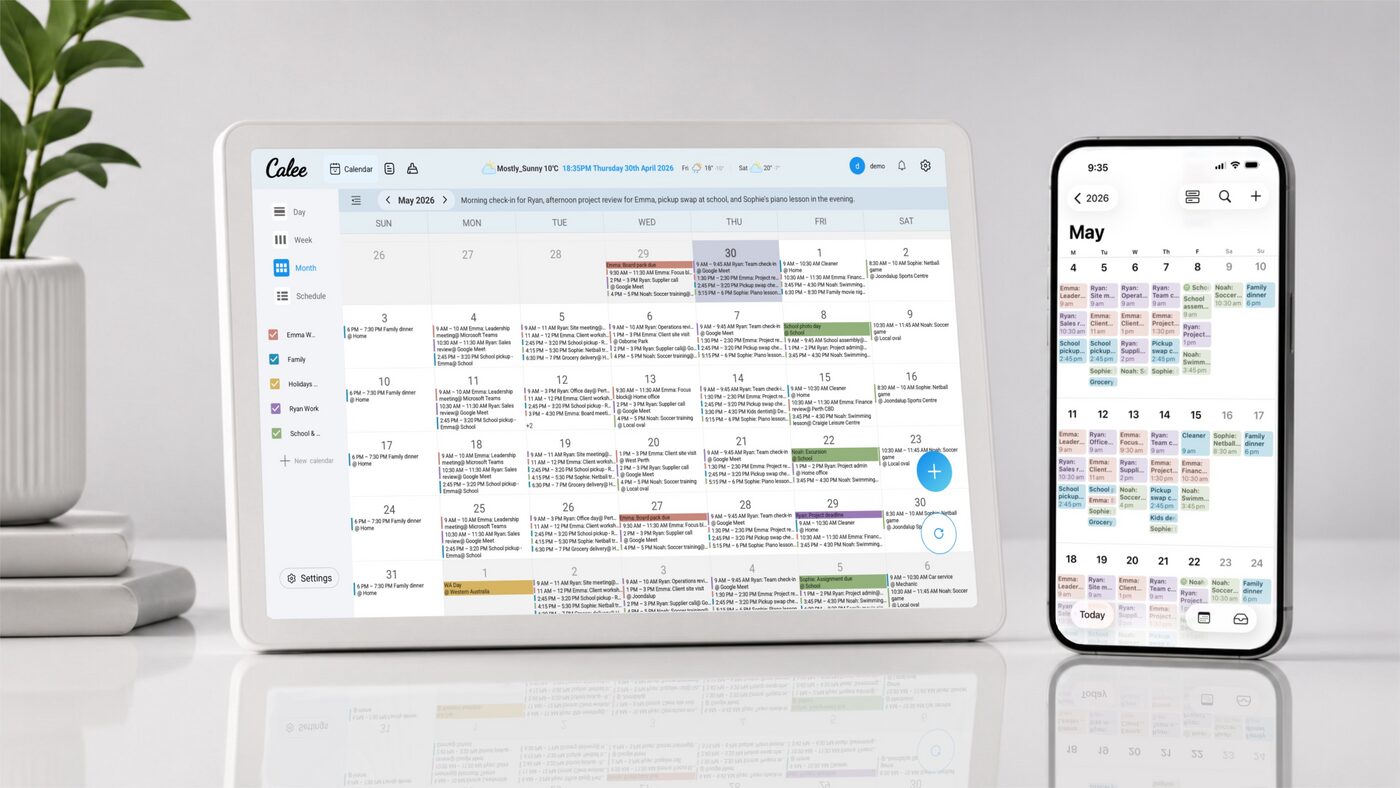
A Calee display and the Calee mobile app side by side, both showing several calendars together in one month view
One endpoint: a followed calendar sitting beside everything else a person already keeps.

Adoption

Works with the systems your organisation already uses

Calee can fit around the way your organisation already manages schedules.

What Calee adds

A structure your audiences can follow

Calendars organised by site, team, program or audience, so a person follows the combination that applies to them instead of one long organisational list.

Distribution that does not depend on re-typing

Update the event once where it belongs. People following that calendar see the revised event when the followed calendar refreshes, so no one has to copy it across.

A way in for people outside your systems

Account-specific access for people inside the organisation, or a published read-only link — shareable by email, your website, a newsletter or a QR code — for people outside it.

What stays in place

Your existing calendar platform

Keep Outlook, Microsoft 365, Google Workspace or iCloud for the jobs they already do. Supported Google, Apple/iCloud and Outlook calendar sources can be connected into the Calee environment alongside Calee calendars.

Connected external calendars are read-only in Calee where applicable, so the system that owns an event keeps owning it.

Your operational and communication systems

Calee does not replace your rostering, booking, CRM, intranet, website or newsletter, and it is not an emergency alert system — keep urgent and same-day changes on your normal direct channel.

Where a compatible calendar feed already exists, it can be connected. Where it does not, that does not prevent a start: calendars can also be created in Calee or built from existing date information provided for import.

Which of your sources are compatible, and how each calendar is shared, is confirmed with your organisation during setup. For the mechanics, see the Calee Calendar Guide and the subscriber guide.

Who it is for

What changes for each group

The same structure answers a different question for each part of an organisation.

Administrators

Structure the calendars, decide which audiences exist and set who can view or edit each calendar.

Organisation-level information stays organised in one place rather than in each person’s copy of it.

Managers and operations

Keep teams, sites and programs working from the same published schedule, with a shared view in the room where that helps.

A change is made once, in the calendar that owns it.

Teams and local staff

Work with the calendars relevant to their site, team or program, without the rest of the organisation’s dates in the way.

Where a calendar is theirs to maintain, they can be given edit access to it.

External audiences

Follow only the calendars published to them — customers, members, residents, participants or families, depending on the organisation.

They never see internal organisational information, and they do not need an account to follow a published calendar link.

Getting started

Getting Calee Business running

A scoped start, reviewed by your team before anyone outside it is invited.

How it works

  1. Show us how schedules work today

    The calendars, files, feeds or pages your organisation already maintains, and who each one is really for.

  2. Map your organisation, calendars and audiences

    We agree the structure: which sites, teams or programs get a calendar, and which audience each one is published to.

  3. Configure the initial scope

    The agreed calendars are set up, with compatible sources connected where they exist and access set per calendar.

  4. Review it with your team

    Your people check the structure, names and dates before anyone outside the organisation is invited.

  5. Launch a pilot

    The agreed audience starts following, while your existing systems and communication channels stay exactly as they are.

  6. Expand when ready

    Review what worked, then add the next site, team or audience. Stopping is a valid outcome.

Start small

You do not have to roll Calee out across the whole organisation to find out whether it helps. A first deployment can be as small as:

  • One site or location
  • One department or team
  • One program or service
  • One calendar group
  • One defined use case, such as a single published external calendar

This matters commercially as well as operationally: because Calee Business is scoped rather than sold as a fixed plan, a small, well-defined first scope is also a practical way to test it before expanding.

Built on Calee Business

Solutions built on Calee Business

Some kinds of organisation share the same shape of problem often enough to be packaged. Each of these applies the same platform to the way that kind of organisation works.

Calee for Education

School-to-family calendar publishing and coordination: schools publish organised calendars once, and families follow the dates relevant to them.

See Calee for Education →

Calee for Sports Clubs

Club and team calendar publishing and family coordination: club and team schedules stay connected to the families who rely on them.

See Calee for Sports Clubs →

These are packaged examples, not the boundary. Calee Business supports organisations well outside these two verticals — if your organisation keeps schedules and needs the right people to have them, it is in scope. Tell us how your organisation works and we will scope it with you.

The Calee range

Where Calee Business sits

Five names, one platform.

  • Calee Home

    For households and families. A qualifying Calee display purchase includes a single-use code to activate Calee Home — see the Calee home page.

  • Calee Business

    For organisations. Everything on this page: organisational calendars, internal coordination, external distribution and optional shared Displays.

  • Calee for Education

    A packaged solution built on Calee Business, for schools. See Calee for Education.

  • Calee for Sports Clubs

    A packaged solution built on Calee Business, for sporting clubs. See Calee for Sports Clubs.

  • Calee Enterprise

    Bespoke, project-based requirements delivered under a project-specific contract, where standard Calee Business is not the right fit. See Calee Enterprise.

Commercial model

Scoped to your organisation, not a one-size plan

Organisations differ enough that a single published plan would be wrong for most of them, so Calee Business is quoted against what you actually need.

What pricing depends on

  • The size of your organisation
  • How many people need access
  • How many locations or sites are involved
  • Whether Calee Displays are included, and how many
  • Onboarding and any setup services required
  • Your support and ongoing requirements

If substantial manual data entry, migration or custom integration turns out to be required, we agree that work and its cost with you before proceeding.

Which is why you can start small

Scoped pricing and a small first deployment go together: scope one site, one team or one published calendar, see what it does for you, and expand from a decision rather than a projection.

Bespoke, project-based requirements are handled separately as Calee Enterprise, priced by agreement under a project-specific contract.

Trust

Australian owned, Australian supported

Calee is built and supported in Australia by My Calee Pty Ltd, ABN 25 674 810 916.

Where Calee sits

  • 100% Australian Owned & Operated
  • Local Australian support during setup and ongoing use
  • Your organisation remains the source of truth for its own dates

How access and control work

  • Your organisation chooses which calendars exist and who each one is shared with
  • Account-specific access at view-only or edit level, or a published read-only link
  • Connected external calendars are read-only in Calee where applicable
  • External audiences see only the calendars published to them

A published link can be forwarded, so use account-specific access where tighter control is needed.

Tell us how your organisation works

Show us the calendars, files or systems you keep dates in today, and we will show you how they could be structured in Calee — and what a small first scope would look like.

Bespoke, project-based requirements are delivered separately as Calee Enterprise.

Book a Calee Business demo

Tell us about your organisation and we will walk you through how your calendars could be structured, who would follow what, and how a first scope would work. Or email info@calee.com.au.

Please enter your name.

Please enter your organisation.

Please enter a valid email address.

A little more, if it is easy

Everything below is optional. It just makes the demo more relevant to you.

We reply within 1–2 business days. This does not sign you up to marketing emails.

Questions organisations ask

Does Calee Business replace Outlook or Google Calendar?

No. Keep them. Calee Business organises your calendars into the structure your audiences follow, and publishes each one to the people it applies to. Supported Google, Apple/iCloud and Outlook calendar sources can be connected alongside Calee calendars, and connected external calendars are read-only in Calee where applicable, so events stay edited in the system that owns them.

Can we use it across multiple locations?

Yes. Sites, locations, departments, teams and programs can each have their own calendar. Your organisation decides which of them exist, what each is called and who maintains it.

Can different teams have different calendars?

Yes, and different access to them. A calendar can be shared with people who have a Calee account at view-only or edit access, so a team can maintain the calendar that belongs to it while everyone else simply sees it.

Can people outside the organisation follow relevant calendars?

Yes. A calendar can be published as a read-only link, which can be shared by email, on your website, in a newsletter or as a QR code. Someone can follow it in the Calee mobile app — a calendar shared through a public follow link can be added in Guest mode, up to five without an account — or add it as a subscription in Google Calendar, Apple Calendar or Outlook. See the subscriber guide.

Do we need Calee Displays?

No. Calee Displays are optional. They are useful where a persistent shared view helps — a reception, a staff room, an operations area — but the platform works on phones, on the web and in people’s own calendar apps without one.

Can we start with one site, team or use case?

Yes, and we recommend it. A first deployment can be a single site, department, program, calendar group or published external calendar. Review what it did for you, then expand. Stopping is a valid outcome.

How is Calee Business priced?

Calee Business plans are scoped rather than sold as one fixed plan. Pricing can depend on factors such as the size of your organisation, how many people need access, how many locations are involved, whether Calee Displays are included, and the onboarding, services and support you need. If substantial manual data entry, migration or custom integration is required, we agree that work and its cost with you before proceeding.

What is the difference between Calee Business and Calee Enterprise?

Calee Business is the standard platform for organisations, scoped to your requirements. Calee Enterprise is for bespoke, project-based requirements: the capabilities, deployment, governance and commercial terms are defined in a contract specific to that project, and pricing is by agreement rather than a published plan.

How do Calee for Education and Calee for Sports Clubs relate to Calee Business?

Both are packaged solutions built on Calee Business. They apply the same platform to the way schools and sporting clubs work, with terminology, calendar structures and onboarding suited to those organisations. Organisations outside those two verticals use Calee Business directly.

Where is Calee based, and how is support provided?

Calee is Australian owned and operated, built and supported in Australia by My Calee Pty Ltd, ABN 25 674 810 916, with local Australian support. General support is at support@calee.com.au.